
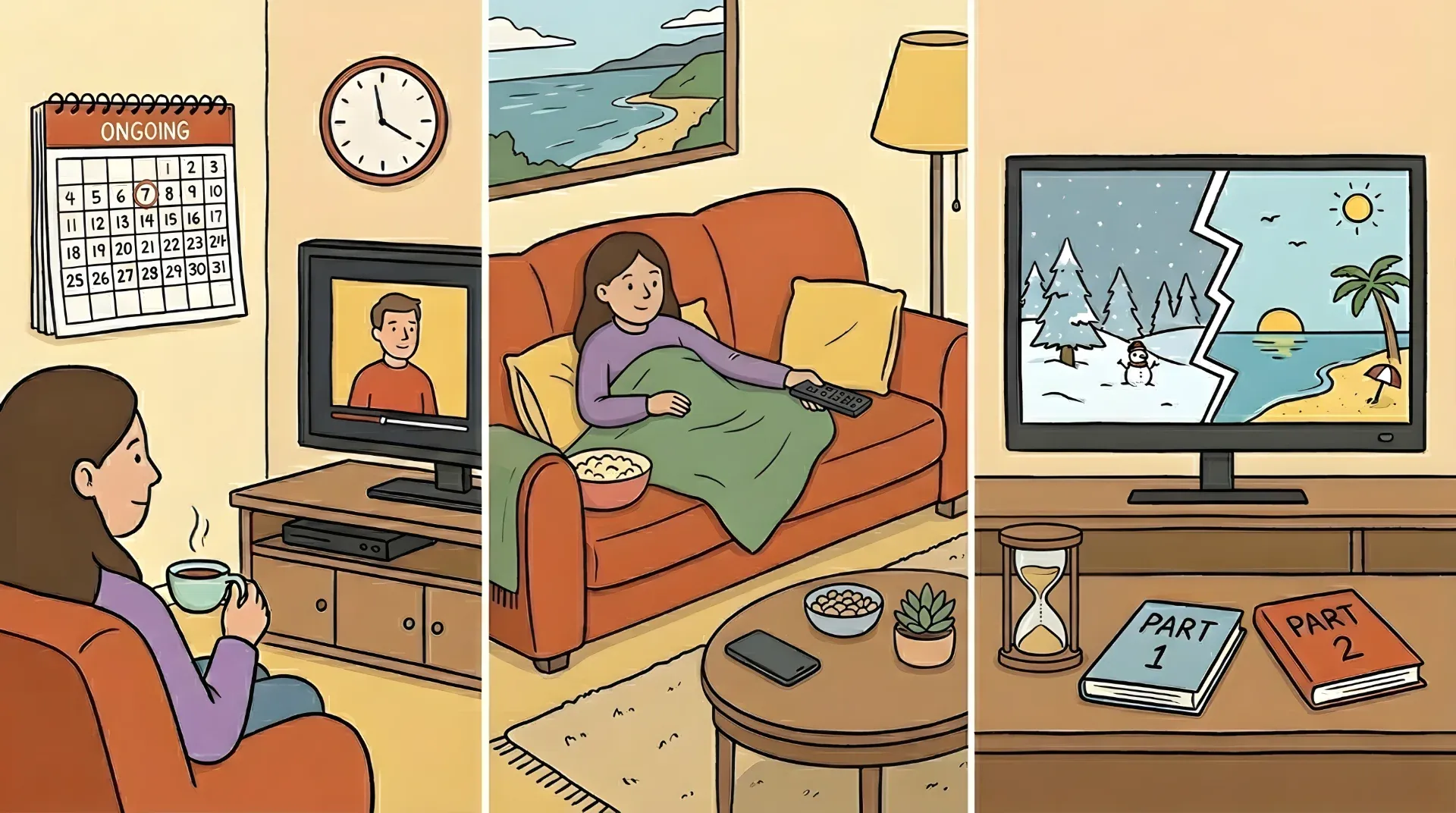
Streaming platforms have taught us to watch television in different ways. Once upon a time we lived from one episode to the next, waiting a full week for the story to continue. Then Netflix popularised the idea of releasing an entire season at once, and suddenly we began devouring shows over a single weekend — or even in one night.
Now seasons are increasingly being released in parts. This shift comes with its own terminology: ongoing, binge-watching, and split season. Behind these terms, however, are very specific rules of the game. Each model shapes how we experience a story, how long a series stays in the public conversation, and even how it is written and edited.
Let’s break down how each approach works, why platforms mix them, and what it ultimately means for viewers.
Ongoing: a weekly ritual
Ongoing is the classic "one episode per week" model. The story unfolds gradually and becomes part of the viewer’s weekly routine.
Its key feature is the pause. A well-known example is Game of Thrones: every episode felt like an event, and the week between instalments gave audiences time to discuss what had happened, develop theories, and return to the story with renewed anticipation.
That is why ongoing releases tend to stay in the spotlight longer. Each new episode becomes a fresh news moment, allowing the series to remain in public discussion instead of disappearing after its opening weekend.
Pros:
- The series stays in public discussion and the media for longer
- Fewer spoilers: many viewers move at roughly the same pace
- The gap creates a sense of ritual and leaves room for theories
- Each episode feels like an event rather than just another instalment in the stream
Cons:
- The waiting can be frustrating, especially when the plot is gripping
- The pacing may feel slower, as the story is stretched out over time
- Some genres, especially thrillers, are better suited to watching without breaks
Binge-watching: a marathon without pauses
Binge-watching is when an entire season is released at once, leaving viewers free to set their own pace — one episode before bed, or "just two more and then I’ll sleep".
Netflix turned this model into a mass phenomenon and effectively made it the default for streaming. If the whole season is already available, why not watch it in one go?
A good example is House of Cards. It was not the first Netflix series to release an entire season at once, but it was the one that firmly established binge-watching as a mainstream viewing habit.
Binge-watching changes how a season feels. The story flows continuously, the context remains fresh in the viewer’s mind, and characters are less likely to fade between long breaks.
But there is a downside: a season can be consumed extremely quickly — and disappear from conversation just as fast. Because viewers watch at different times and at different speeds, even major premieres sometimes become brief bursts of attention: a few days of buzz before audiences move on to the next release.
Pros:
- There is no need to wait for the next episode — the story is always there when you want it
- Maximum immersion: the plot does not have time to fade from memory
- Full control over the pace — you watch whenever and however it suits you
Cons:
- The series tends to disappear from the conversation more quickly, as the hype is shorter-lived
- Spoilers are harder to avoid because everyone is on different episodes
(best stay off TikTok) - It is easy to burn out if you watch the whole thing in one go
Split season: a compromise between binge and weekly releases
A split season is a hybrid approach. The season is divided into two — sometimes three — parts that are released with a break in between. Platforms often label them as Part 1 / Part 2 or Volume 1 / Volume 2.
In practice, viewers receive a small batch of episodes to binge, followed by a controlled pause — similar to the weekly model.
One of Netflix’s most visible examples is Stranger Things Season 4, which was released in two volumes. The first part triggered a mass binge-watching moment, while the break before the second volume recreated what ongoing releases typically achieve: time for discussion, theories, and shared anticipation of the finale.
Pros:
- A compromise: you can binge part of the season, but still get a pause afterwards
- Two or even three waves of discussion instead of just one
- The season stays in the public conversation for longer
- The break gives viewers time to process events and come up with theories
- It is easier to watch in step with others, with less spoiler chaos
Cons:
- The break can be frustrating if it comes right at the most exciting moment
- It may feel artificially stretched out, which can put some viewers off
- There is a risk that different parts of the season will feel uneven
- The pause can disrupt the pacing and emotional momentum
Why platforms mix release models
In streaming, the most valuable currency is not the opening weekend buzz but the subscription that viewers either renew or cancel.
A pure binge model can encourage a simple pattern: subscribe for a month → watch the entire season over the weekend → cancel the subscription. To counter this, platforms mix release strategies.
Weekly releases and split seasons stretch a show’s presence over time, create multiple reasons for viewers to return to the platform, and reduce the chance that a series will burn through all its attention in a few days.
At the same time, pauses synchronise the audience, prolong discussions, and increase the likelihood that new viewers will discover the series while it is still being talked about.
Now you know what ongoing, binge-watching, and split seasons are — and how these formats help streaming platforms keep both your attention and your subscription.